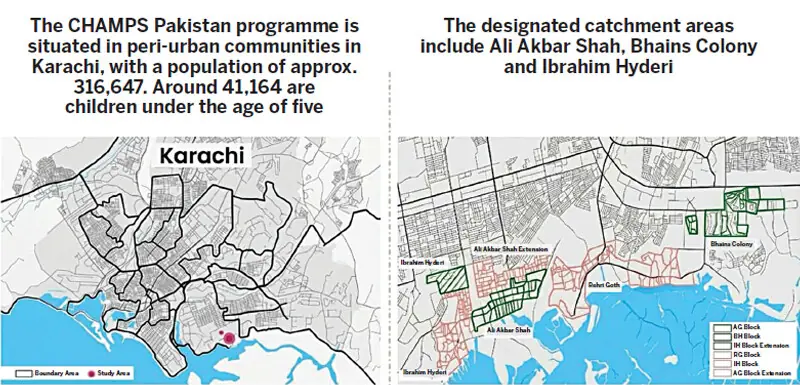
At first glance, the Changan Karvaan parked outside one of Aga Khan University’s (AKU) field sites in Karachi’s Bhains Colony looks like an ordinary white minivan. Boxy, tinted windows, no markings to set it apart. It’s only when you get in that the disinfectant and medical equipment give it away.
Under the bright clinical lights, you will find surgical gloves, syringes, tissue covers… everything needed to perform MITS, or minimally invasive tissue sampling, on even the smallest of babies in the localities of Ali Akbar Shah, Ibrahim Hyderi and Bhains Colony.
This unusual approach to forensics has helped researchers paint one of the clearest pictures yet of why these babies die before their fifth birthday.
In three of Karachi’s poorest neighbourhoods, a minimally invasive autopsy technique is doing what verbal accounts and hospital records couldn’t: naming the exact cause of death in babies before age five
WHAT IS MITS
In 2015, the Gates Foundation launched the Child Health and Mortality Prevention Surveillance (CHAMPS) programme to better understand why babies and young children die in poor countries.
It was coordinated by University of Texas, Southwestern Medical Centre and aimed to combine clinical records, laboratory testing, verbal autopsies and, where families consent, MITS, to pinpoint the biological causes of stillbirths and deaths among children under five.
MITS is a post-mortem exam in which tiny amounts of tissue and fluid from key organs are taken using fine needles. These samples are analysed for pathogens, infectious disease and malignant tumours. The results reveal the exact cause of death without a full surgical autopsy.
The goal is to arm governments and health agencies with evidence, so they can tackle preventable child deaths. “Children die because of certain reasons — there’s intrauterine deaths, which are before birth,” says Dr Asim Beg, parasitologist at AKU who specialises in vector-borne diseases. “The real cause for those is also more speculative because, in Pakistan, a Muslim country, they don’t do post-mortems normally,” he tells Eos.
The study operates across nine countries on two continents, but Pakistan posed an obstacle unique to it: a widespread religious conviction that invasive sampling would disrespect the dead.
It took at least 28 fatwas [religious edicts], countless meetings and debates with local leaders, and deep community involvement before families started to consent.
“When the surveillance team first approached families, the response was overwhelmingly negative,” says Sajid Abbas, a research manager for the study. “At least 60 to 70 per cent of households refused outright.”
The data collected from a MITS sample is just as comprehensive as what you’d get from a full open autopsy, according to Dr Momin Kazi, the study’s lead researcher. Tissue is collected from the brain, heart, lungs and kidneys, and, for stillbirths, the placenta is taken in its entirety. Organ samples are obtained through a puncture no larger than a pen’s tip, alongside cerebrospinal fluid, nasal, rectal and stool swabs, plus biometric measurements and photographs.
MITS identifies the cause of death in 98 to 100 per cent of cases, researchers say, because they draw on polymerase chain reactions (PCRs), chromatography, and every other test available.
That level of accuracy is possible because findings are deliberated upon by a panel of 12-13 experts, including professors, government representatives and specialists from private hospitals. They systematically eliminate possibilities to find the cause. Often, the visible symptoms were the ones already treated, but an underlying condition went undetected, with no symptoms.
The sample size isn’t yet enough for policy, researchers say, but MITS has revealed unprecedented detail: exact pathogens, hidden causes beneath treated symptoms and new local strains no other method would catch.
Researchers deliberately chose this stretch of Karachi’s coastline as a study site because it functions as a “mini Pakistan”, with families from all linguistic backgrounds and faiths.
RACE AGAINST TIME
When a stillbirth occurs or a child under five dies, burial usually happens within two to four hours — arrangements are minimal, beyond a ghusl [ritual bath] and shrouding. Many such deaths happen at home and are rarely logged with a hospital, leaving the cause unknown.
The team’s challenge was to even find out about these mortalities.
“It’s not as if every death comes through a hospital,” says Abbas. So the team mapped out the path a burial takes and everyone involved, at every step — a network that included religious figures who lead burial rites, shopkeepers and coffin makers, informal healthcare providers, ambulance drivers, and even nightwatchmen.
“These are the people who alert us, and our team is available around the clock to respond, reach the family and seek consent for a sample,” explains Abbas.
Mirzaadi is one such woman. She’s spent years as a community health worker in Bhains Colony, logging new families, marriages, births and deaths, long before CHAMPS operated in the area. When her daughter Rafiya was born at Koohi Goth Hospital two years ago, the baby hadn’t cried or urinated since birth.
“She was passing discoloured fluid from her mouth,” Mirzaadi recalled. The family was told that the child’s organs were damaged. She was eventually put on a ventilator and died 12 days later.
With Mirzaadi not in a state to engage, the project team quickly took consent from her husband Mushtaq, himself a senior research assistant on CHAMPS. The blood culture result following MITS indicated that Rafiya’s likely cause of death was acute gastroenteritis. It wasn’t her kidneys as initially suspected. The culprit was the qehva [green tea] that was given to the newborn.
According to Dr Vinod Kumar from The Indus Hospital, common practices such as prelacteal feeding (giving any substance other than breast milk to newborn babies during their first threedays) compromise a baby’s health. “[People say] let’s give honey, or water, or qehva or unpasteurised goat milk,” he tells Eos. Any of them can lead to an infection.
MITS has helped families uncover the reason for multiple child deaths. In one case, for example, a virus was detected and treated so the couple’s subsequent children survived. A child infected with Streptococcus pneumoniae, for instance, might also test positive for cytomegalovirus — these opportunistic pathogens strike children who are already sick and more vulnerable.
A child placed on a ventilator who then develops ventilator-associated pneumonia, for example, points to a clear, fixable gap: infection control on the equipment itself needs to improve.
LOCAL BUGS
The pathogens behind neonatal sepsis in Pakistan, according to neonatologist Dr Kumar, look nothing like what doctors encounter in higher-income countries.
“We majorly deal with a few of the common bacterial organisms, which include Klebsiella pneumoniae, Acinetobacter, Staphylococcus aureus, and E. coli,” he says, contrasting this with the Group B Streptococcus that dominates in Western neonatal units.
Most of these bugs are hospital-acquired — a consequence of overcrowded wards, thin nursing ratios, where “one nurse is looking after four or five babies, or sometimes eight”, making cross-infection almost inevitable.
CHAMPS’ initial data supports this. Hospital-acquired and drug-resistant superbug infections, such as Acinetobacter baumannii, Klebsiella pneumoniae and Pseudomonas aeruginosa, occurred overwhelmingly or exclusively in hospitals, showing how drug-resistant bugs thrive in clinical wards
The initial data shows a stark contrast between deaths taking place at home and those at a hospital. Measles was the leading cause of death, indicating that these children were not getting their routine immunisation. More troubling was that Streptococcus pneumoniae (six cases) occurred exclusively at home — proof that fatal respiratory infections were killing children before they ever reached a hospital.
Among the deaths for which parents consented to MITS, 31 percent were stillbirths, 63 percent involved infants younger than one year of age and six percent occurred among children aged one to five.
Although child mortality in these coastal neighbourhoods remains alarmingly high, families now have something they previously lacked: the chance to know exactly why their child died.
The writer is a member of staff. She can be contacted at yumnakhan@outlook.com
Published in Dawn, EOS, August 2nd, 2026
from Dawn - Home https://ift.tt/XPiTZKd
Comments
Post a Comment