On paper, Pakistan is a recycling success story. On plastic, not so much. Bad puns aside, the World Bank has said we beat all of South Asia with the lowest marine plastic pollution rates. Those in the business will tell you Pakistan is flipping trash so well that it now imports used gallon milk jugs from Ohio, and may teach Saudi Arabia how to turn it into street pavers. Why bother with cloth bags and paper straws if we are already recycling kings? Because of biscuit and chips packet wrappers and the question of what happens to them. And what I discovered in Shershah.
Karachi’s Shershah market is a byword for recycling, but over the years, fussy power supplies have hemmed business into a corner of the neighbourhood called Paracha, named after a textile mill. What I saw at these small setups here is the part of Pakistan’s success story that no recycler brings up.
You know how it works. Labourers sort household trash by colour, discard what can’t be recycled, and feed the rest into a crusher. A black oozing sausage emerges from what looks like the meat-mincing machine and is fed through another that shapes it into long, thin strips. The strips are cooled in metal tanks filled with water and then cut into one-millimetre pellets, or dana. That dana is used to make new plastic babies. And the cycle continues.
One unit at Paracha was producing green dana or pellets; another three doors down was turning out cleaner ones from unused medical waste. But dana wasn’t the only end-product, I realised. “What’s that on the floor?” I asked the men. I was pointing to coal-like blobs. That’s gatha, they said. Factories and kilns buy it as cheap fuel.
Gatha energy blocks are made from compacting or melting together one of the most useless, least valuable and most problematic forms of plastic waste: MLP or Multi-Layered Plastic. This is the plastic that you tear off and chuck every time you eat a tikki pack of 2 biscuits or tear open a packet of chips, or even that tiny tinsel paan/chaalia pouch or even a medicine strip. This food-grade packaging is thin and does not look like plastic, but it can run four layers deep. The outer layer of Biaxially Oriented Polypropylene (BOPP) or Polyethylene Terephthalate (PET) plastic serves as the printing surface. Then comes an adhesive layer, and an inner sealant layer, usually Cast Polypropylene (CPP) or Low-Density Polyethylene (LDPE).
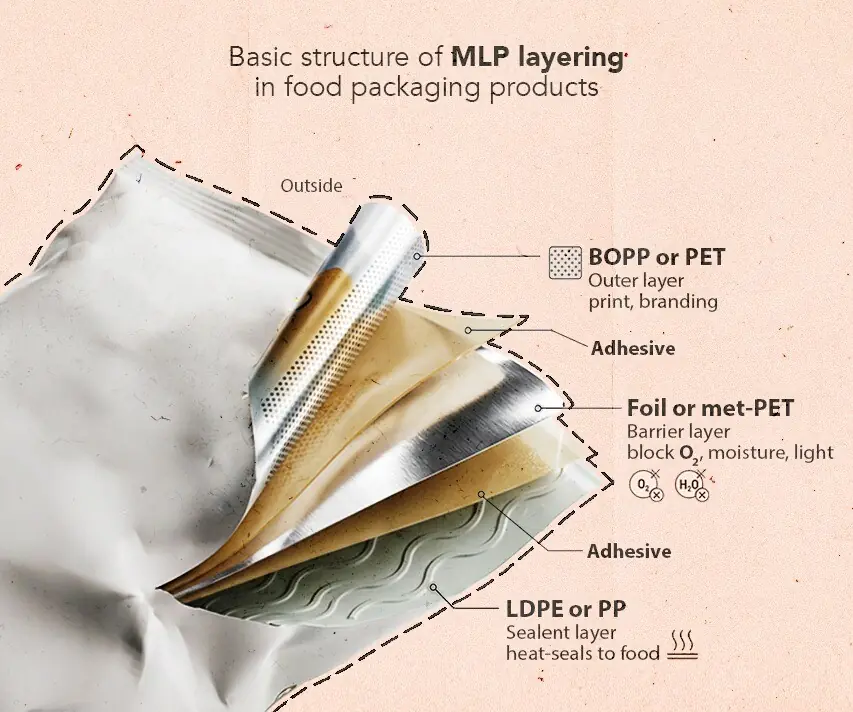
Manufacturers often add a pure aluminum or metallised film either to extend shelf life or to give it a glossier, premium look. That is why MLP is also called ‘chamak patti’. According to supplier Hasan Khanani, who owns Metatex, some MLPs run seven layers deep. Try taking one apart to see for yourself.
Internationally, the closest equivalent to MLP-origin gatha is called Solid Recovered Fuel in regulated economies such as the UK and Europe. Cheap Solid Recovered Fuel is used by cement kilns and other high-heat industrial factories but abroad, they are watched like a hawk by the government because burning them poisons the air with heavy metal and acid gas. In Karachi, gatha is also popular as a cheap fuel with off-the-books textile dyeing units, and small steel re-rolling mills deep inside residential areas like Scheme 33 and at kilns on the outskirts of the city.
MLP is a problem child in the grand scheme of plastic recycling. The more layers a wrapper has, like MLP, the harder and more expensive it is to recycle. Each type of plastic has a different melting point, so each recycler will specialise in the plastic they can cost-effectively melt. Different machines work for grades of plastic. In MLP’s case, each layer melts at a different temperature and needs a different machine. This is why easier-to-melt-in-one-machine plastic bottles can fetch up to Rs150 per kilogram, but the mixed MLP waste sells for just Rs6, according to Irverde’s CEO Angel Imdad.
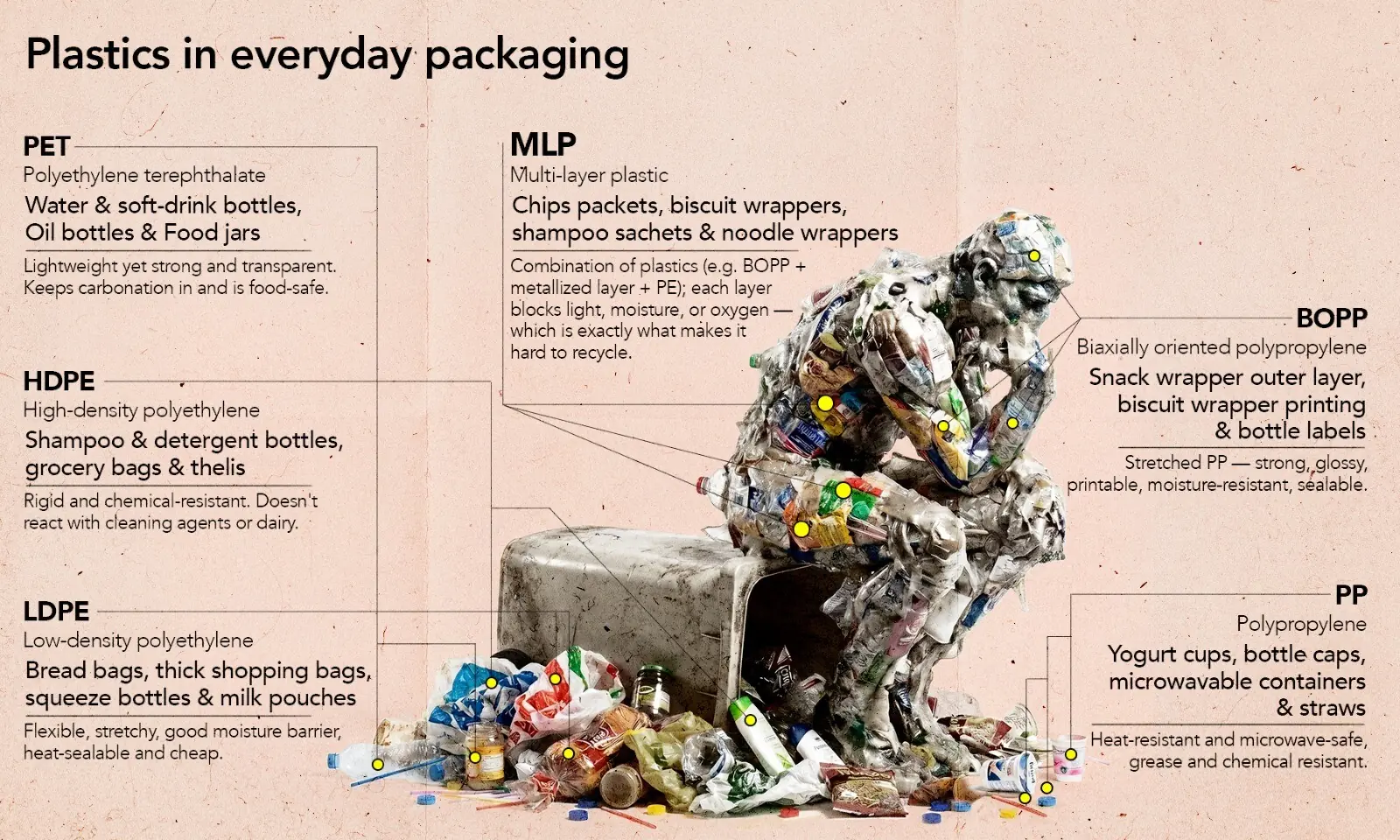
MLP is also absurdly light so you need to recycle a lot to recover costs. It’s so light that a single PET bottle weighs roughly the same as 100 MLP wrappers, which is exactly why waste pickers would rather chase bottles than wrappers. “It isn’t viable to spend Rs20,000 to transport MLP, as its volumetric weight is a lot more than its physical weight,“ Imdad said. “People don’t even reach breakeven.”
This is why, sources said, informal recyclers just burn MLP waste in an open karahi-like container, turning it into sludge. That is spread out, cooled off and broken into rock-solid blocks called gatha. If you want to recycle it more responsibly, you can use two techniques. One way is mechanical compaction, in which the sorted MLPs are squeezed together using strong pressure, binding them into a sticky block which hardens once cooled. In this method, the plastic is kept well below its flashpoint so no harmful emissions are produced.
The second formal method for recycling MLPs into energy blocks is Pyrolysis, which requires heating it to high temperatures (between 450°C and 650°C) in an oxygen-deprived environment. Any oxygen in the reaction chamber will instantly combust the plastic, reducing it to ash. But starved of oxygen, the heat safely breaks the molecular chains of the plastic polymers into their petroleum derivatives. When cooled, the block is ready to be used as an SRF.
Importantly, the second method, pyrolysis, is a process that involves melting, not burning. Not only does burning reduce the efficiency of the energy output of the SRF, but emissions, if not captured, introduce toxic acid gases, heavy metals (like mercury and aluminium) and chlorine, and even hydrochloric acid into the air, posing a deadly risk to public health.
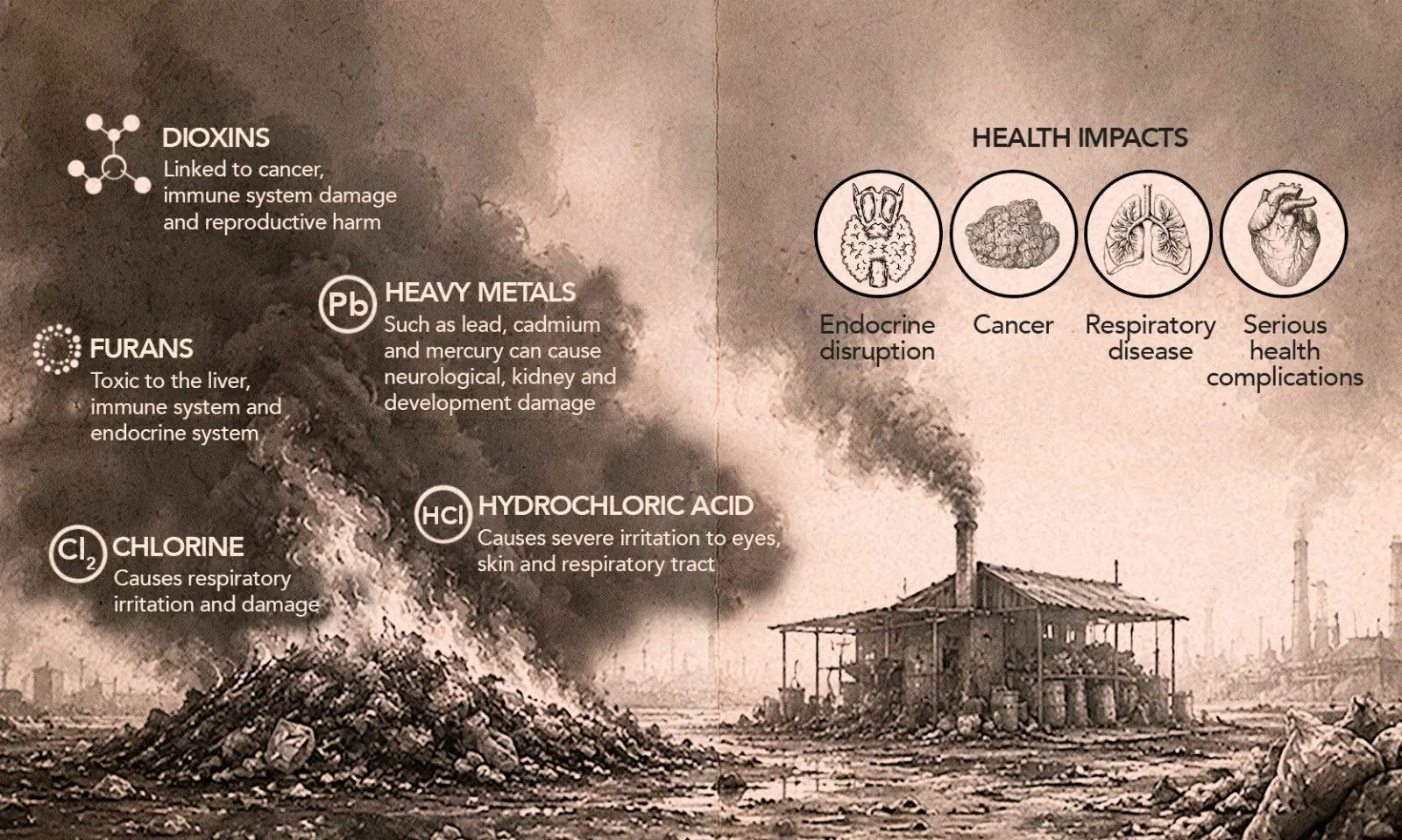
The informal practice of burning MLPs in an open karahi and turning it into petroleum sludge seemed at first to be a crude version of pyrolysis. But it was burning rather than melting the plastic in an oxygenated open-air environment. Emissions were certainly not controlled and no safety precautions were taken for workers.
Finding recyclers who work with MLP directly proved difficult. Most experts either advised against pursuing it or said the recyclers would refuse to meet, aware, as they are, of the legal ambiguity of what goes on behind closed doors. One source said these operations move around to avoid being caught.
Worse, researchers have found that small-scale, community-level burning of mixed plastic waste can pose a greater health risk than large-scale dump fires, precisely because residents are exposed.
Put together, the two ends of Pakistan’s informal recycling economy, the open burning of MLP in the production of SRFs and the unregulated usage of SRFs/gatha, tell the same story: recycling, but like this doesn’t cancel out the harm of plastic waste. It just relocates it, from a landfill to a lung.
from Dawn - Home https://ift.tt/D39Voqs
Comments
Post a Comment