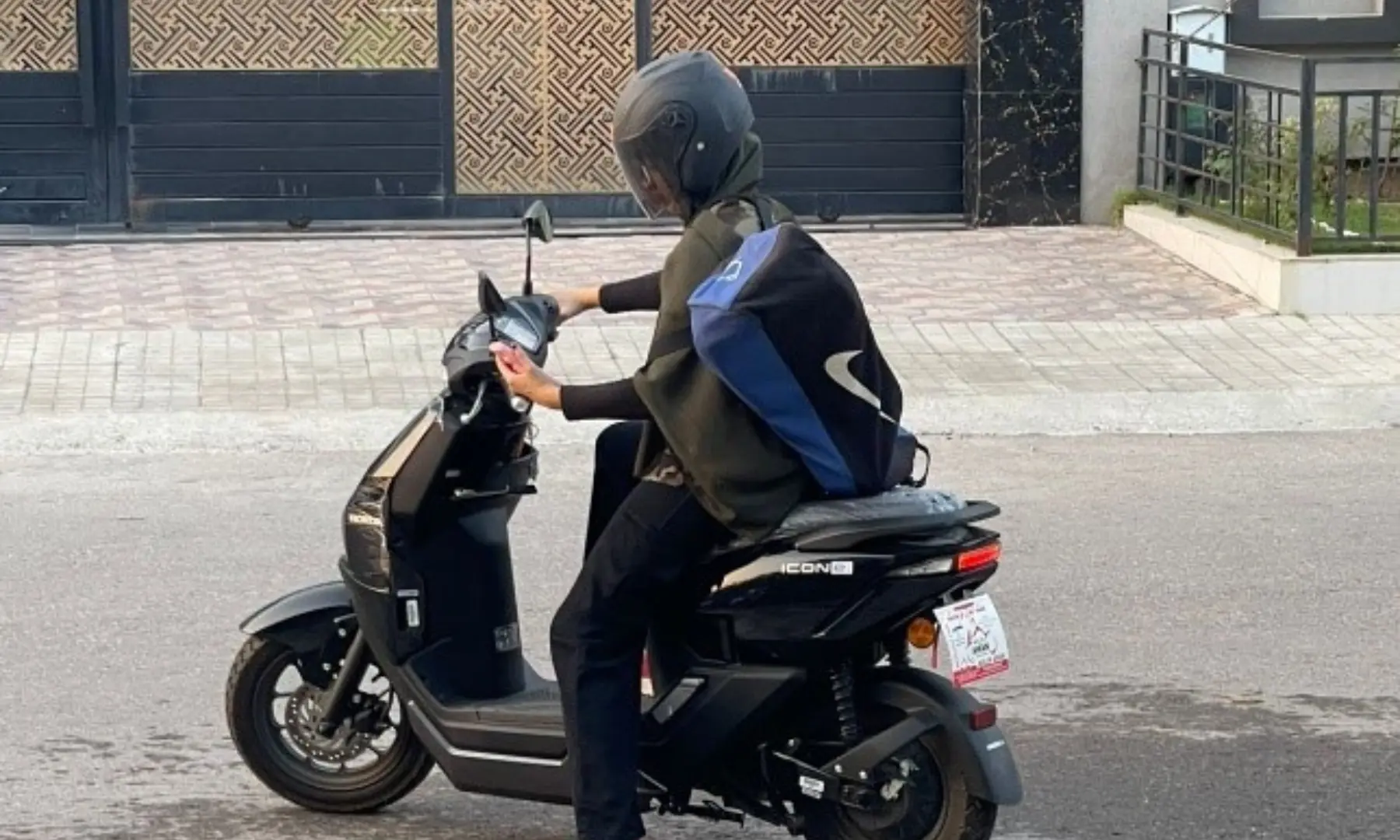
Esha named her scooty Riri, after herself.
It cost Rs420,000 and she hasn’t spent a rupee more since on transport. Every time the scooty hums to life—when the 22-year-old leaves for classes at the College of Electrical & Mechanical Engineering—heads turn. “My friends think it’s cool,” she says. “Young women light up in public. They say it looks easy to handle.” Their reaction means everything to her.
In a country where a woman’s movement is still being negotiated, the sight of a young woman riding an electric bike is its own argument. Esha has thought carefully about why that argument meets resistance. “One, the upfront cost. But honestly, why would a family invest in a scooty for their daughter when bhai is around as a free drop service?” she says. The second resistance comes from the feeble ‘log kya kahenge’ and ‘kuch ho jayega road pe’ fear. And lastly, Esha believes that women’s independence makes men uncomfortable. “The control only works when we’re dependent,” she adds.
The economics of freedom are hard to argue with, though. Pakistanis have, in the last year or so, been floored by soaring petrol prices that electric two-wheelers are beginning to find their riders. A monthly fuel bill of Rs12,000 has doubled now.
For Esha’s family, the math resolved itself: a steep upfront cost, undeniable long-term savings, a lighter machine that felt safer on the road. She charges the bike every night for a fraction of what petrol would cost, riding more than 60 kilometres without stopping at a pump or asking for a lift. “My family is supportive because they know I’m safe,” she says.
Sana, 24, a NUST student from DHA Rawalpindi, came to the same conclusion but through a different door. She didn’t choose her electric scooty because it was trendy. Petrol bikes frightened her: the weight, the kick-start, the quiet dread of breaking down alone. But the scooty felt like something she could manage on her own, without depending on anyone.
There’s also a physical safety consideration. “My engineers who wear abayas have suggested designing scooters because they are easier to ride in modest clothing and are socially perceived as more appropriate,” says Dr Azir of the Institute of Energy, Climate and Equity at the University of Lahore.
The market was listening. Whether policy has caught up is another matter.
Policy: promise and gap
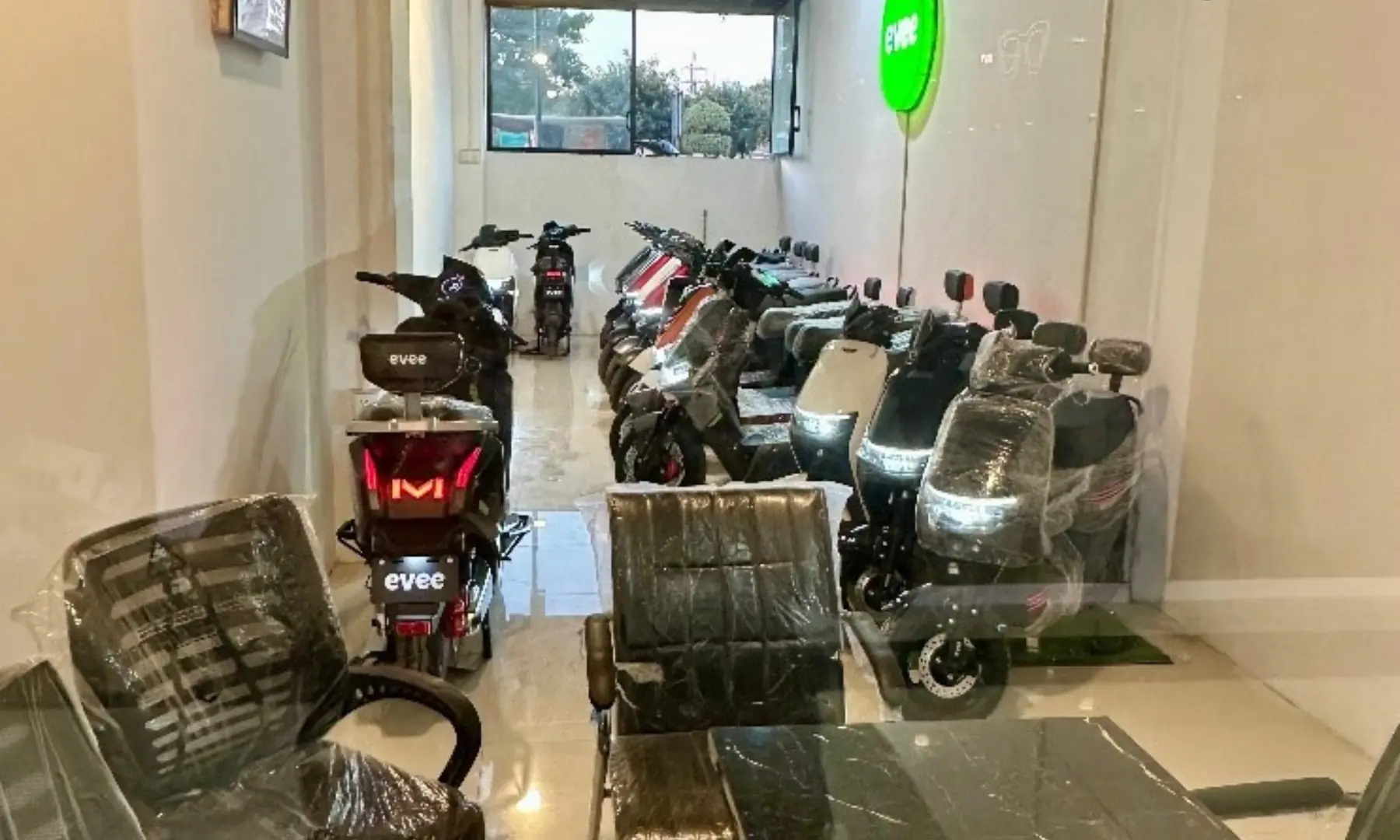
The federal government’s PAVE initiative has set an ambitious target: 116,000 electric bikes and 3,000-plus rickshaws for the current fiscal year, a 30 per cent EV sales target by 2030, and a Rs2.5 per litre levy on petrol to fund subsidies. Minister of State Dr Shezra Mansab Ali Khan Kharal says the government is encouraging the provinces to launch women-specific mobility schemes, including subsidised scooters and concessional loans.
The on-ground reality has been considerably more modest. As of the last reported period, only 5,409 units had been distributed—roughly 4.5pc of the annual target. Commercial banks approved only around 9pc of EV loan applications, rejecting the rest.
In a painful irony, the levy funding EV subsidies falls disproportionately on petrol and diesel consumers—who tend to be middle and lower-income—to subsidise a technology that benefits higher-income buyers more. Structural fixes are underway, including a model according to which people pay the subsidised price directly, and a Rs10,000 upfront scheme for lower-band government employees. But these options assume a person is formally employed and have institutional legibility that many workers do not.
The recently announced federal budget offered a modest boost to Pakistan’s electric two-wheeler market by extending existing incentives on completely knocked-down (CKD) kits for electric bikes, three-wheelers and other EVs until June 30, 2027. This means local assemblers can continue importing EV components at concessional duty rates, helping keep prices lower for consumers. The budget introduced no new taxes on electric bikes. While these measures provide stability for the sector, the distributional impact of the budget remains largely unaddressed, raising the question of who actually benefits from it. Every year, the budget is presented, yet little attention is paid to its distributional consequences.
For those who already cannot afford an electric bike, the budget does not reduce the upfront costs that keep electric mobility out of reach for many low-income consumers. The extension may ease costs for manufacturers, but its benefits are not guaranteed to reach consumers.
On the other hand, Pakistan has nearly 30 million petrol motorcycles which eat up about 40pc of national petrol supplies, draining roughly $6 billion annually in imported fuel, according to Federal Energy Minister Awais Ahmed Leghari.
Class, charging, and the limits of revolution
Forty kilometres from where Esha rides, Nazia, 30, a house helper from Rawalpindi, makes the same daily commute on a petrol bike that belongs to her brother. She leaves at 8am and returns by 6pm, spending around Rs700 on fuel, contending with pump queues where men stare and workers are hostile, with no slack in her system if she arrives late. The brother gave her the bike out of necessity—he plays snooker while she earns for the household—and taught her to ride it only after she insisted.
The daughter of one woman Nazia works for recently bought a beautiful red Honda electric bike. Nazia has thought about this. “Forget buying, even the showrooms feel out of reach,” she says. She has never gone inside one. The batteries don’t last, “like phone batteries” and she cannot afford to be stranded mid-shift. The higher electricity bill from overnight charging, layered onto a household without solar panels and a cost of living already at its limit, produces a dread that subsidised purchasing schemes do not address. And there is so much English written on electric bikes. She doesn’t think she would be able to understand the instructions herself.
Nazia is not resistant to electric bikes. She simply doesn’t trust a technology she cannot decipher, afford, or get repaired, in a city without charging stations, while working a job that allows no margin for mechanical failure.
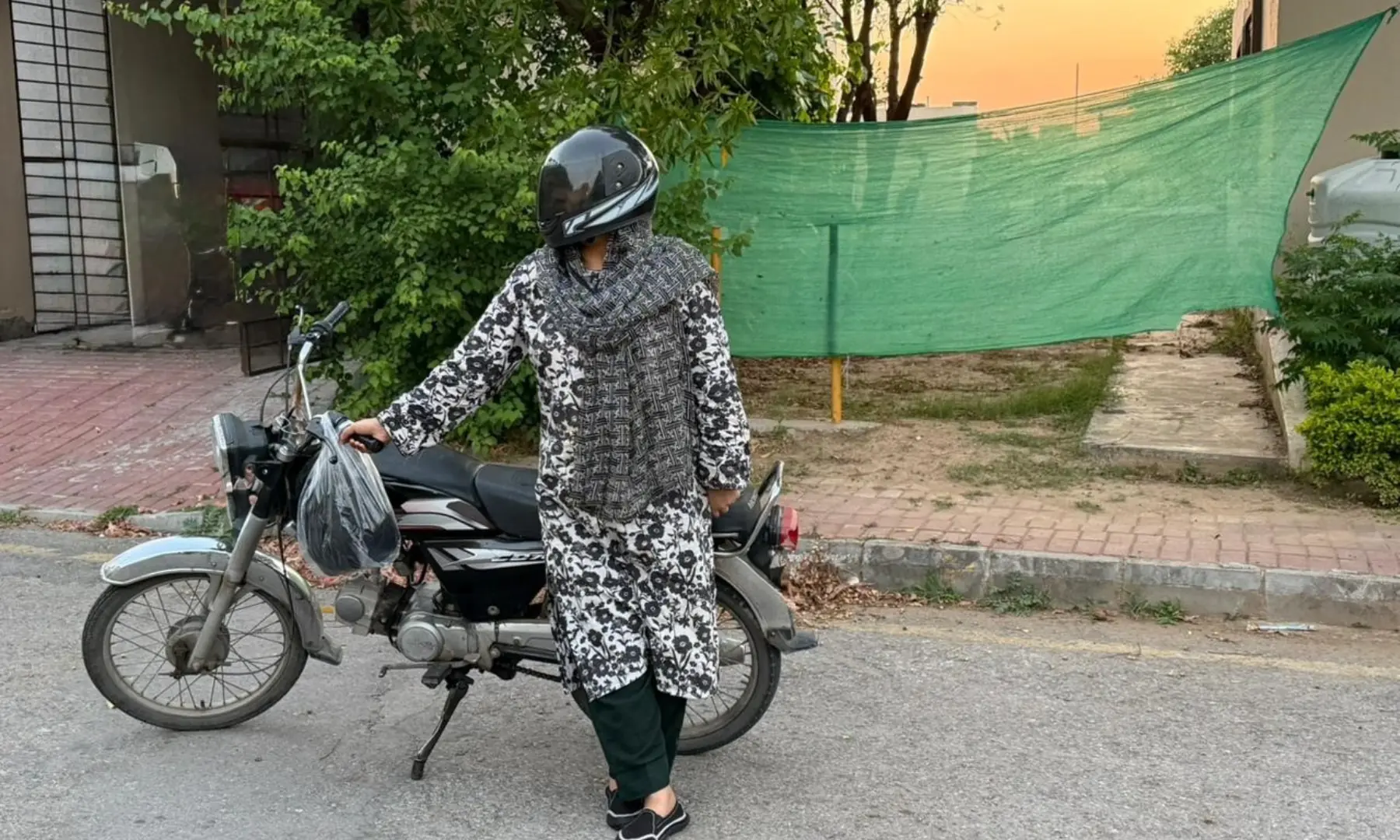
In Karachi, journalist Anum Razzaque expressed the same hesitancy. “The city’s broken roads, long travel distances, lack of charging stations, and the high cost of batteries make petrol bikes feel far more practical and reliable,” she says. “Even a few minutes of rain can be a problem if the bike shuts off, and without mechanics available, I wouldn’t know how to restart it.”
This is not a niche concern. Usama, 28, Islamabad, Yadea Dealer, one of the country’s more established EV brands, says the biggest challenge in Pakistan right now is the charging infrastructure. Electric bikes are better suited to smoother urban surfaces.
A just transition or just a transition?
On paper, the principles are simple enough: the costs and benefits of an energy shift must be shared fairly, with no one left carrying a disproportionate load. Pakistan’s EV moment, as it stands, hasn’t cleared that bar.
Yet inclusion alone won’t resolve the deeper structural question Dr Azir raises: who gets left behind? Without deliberate policy, he warns, the transition fractures into two lanes—one fast and paved for the wealthy, the other a dead end. Pakistan has already rehearsed this inequality. The Audi e-trons arrived first, priced for drawing rooms rather than daily commutes. The technology eventually trickled down. Equity, however, rarely follows uninvited.
The fault lines are already forming: rural women excluded as charging infrastructure clusters in major cities; low-income buyers hitting financing walls; informal workers rejected by credit systems built for salaried employees; women without digital banking locked out of app-dependent mobility platforms altogether. And underneath it all, a slow-burning time bomb—battery replacement costs that could convert today’s savings into tomorrow’s debt.
Harder still, there are the workers nobody is talking about: petrol pump operators, motorcycle mechanics, station attendants—an entire informal economy quietly facing obsolescence. A genuinely just transition would bring them into the room: converting petrol stations into hybrid energy hubs, reskilling mechanics for EV maintenance, building Urdu-language, audio-guided service infrastructure that women like Nazia could actually navigate. Because transitions, like roads, are never neutral. They are built by someone, for someone. And that someone determines everything that follows.
There is a deeper contradiction beneath it all. A scooty charged on a coal-powered grid is not a clean solution; it is a cleaner one. Electrifying transport without decarbonising generation merely shifts dependence; it doesn’t end it. Solarised rooftops, distributed renewables, a genuinely greening grid are not footnotes to the EV story, they are its spine. Pakistan’s ambitions, to be fair, are not small. Climate Change Minister Shezra Mansab Ali Khan Kharal points to over 33 GW of installed solar capacity and a pledge to cut carbon emissions by 50pc by 2035. But ambition and architecture are two different things and the gap between them is where the most vulnerable tend to fall.
The electric scooty will not fix Pakistan’s roads, its grid, its gender politics, or its economy. But in the hands of the right policy, the right infrastructure, and the right intent, it could offer something this country has rarely delivered to its women with any consistency: the simple, radical freedom of going where you need to go—charged, unaccompanied, and entirely on your own terms.
Header image: Esha, her electric scooty, and Daisy. — all photos by authors
from Dawn - Home https://ift.tt/xPaoCd3
Comments
Post a Comment