The traditional global asset correlations that collapsed when the war in the Middle East erupted remain broken, leaving investors to piece together strategies to trade the road to resolution with a faulty instrument panel.
Record highs for Wall Street stocks belie concerns about fraught geopolitics, how long energy supplies might be disrupted for and long-term economic damage.
BMO chief FX strategist Mark McCormick reckons the next three to six months will not resemble the “pre-conflict normal”.
“The growth factor is recovering, but remains below late-2025 levels, the rates (monetary policy) factor remains elevated, correlations are shifting, and drawdown risk is rising. Something new is forming,” he said in a note.
Here’s a look at the disruption to classic correlations in stocks, bonds, currencies and commodities that have traditionally provided a steer on economic trends.
A hard test for fixed income
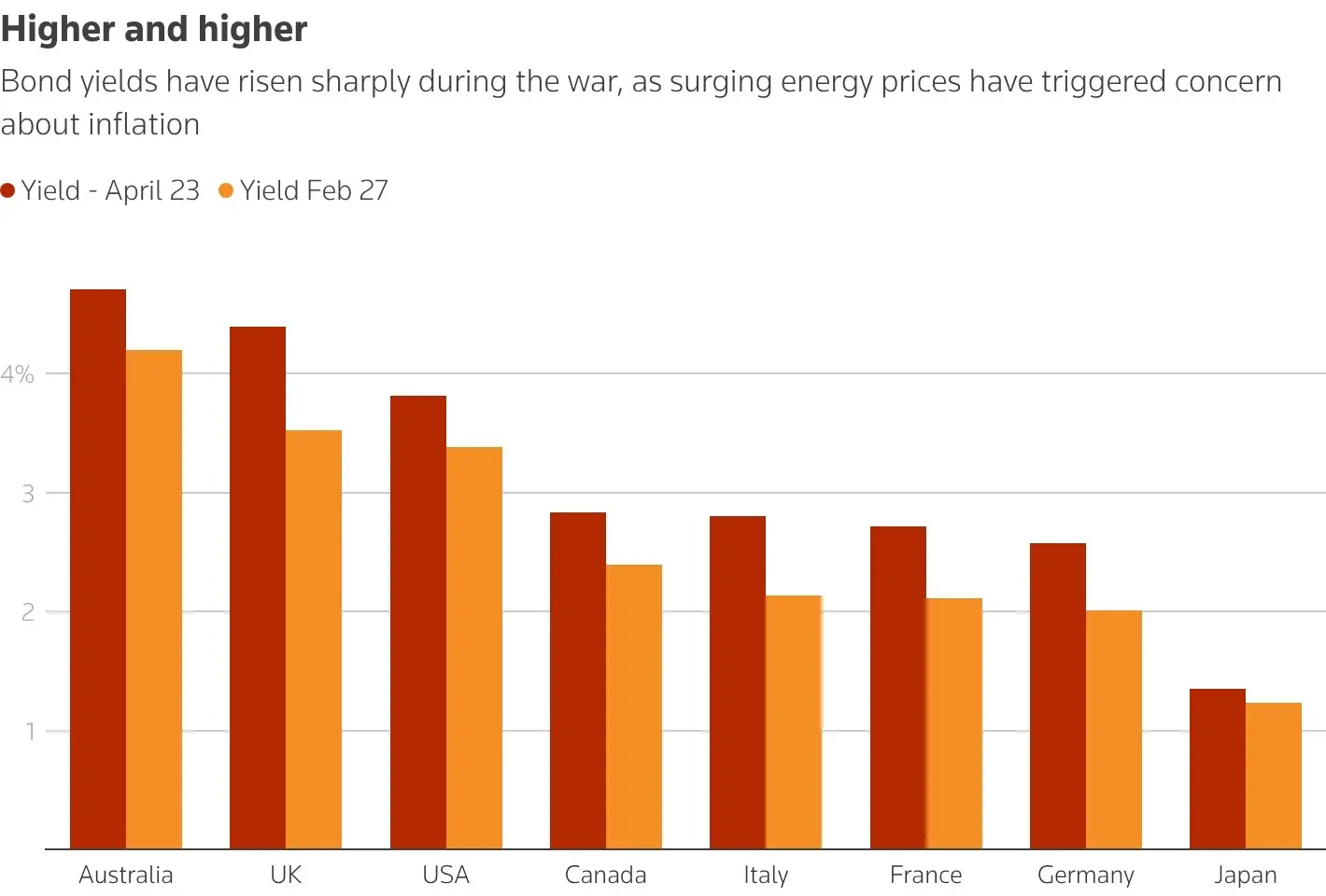
Stocks and bond yields usually move together, as investors tend to hedge economic growth worries, which hit stocks, by buying bonds, sending yields lower and vice versa. That relationship has been more erratic since the pandemic, as higher inflation and government debt undermine the ability of bonds to act as a hedge against equity risk.
The International Monetary Fund (IMF), in a pre-war blog in February, warned that investors and policymakers must rethink risk management for “a new era” where traditional hedges fail.
Two-year bonds, sensitive to inflation and interest rate expectations, have been in the eye of the storm.
The one-month rolling correlation between two-year Treasury yields and the S&P 500 has collapsed to around -0.8 from an average of 0.23 over the last five years.
Since the war started, that metric is at -0.63. A near-identical pattern emerges for two-year German yields and European stocks.
“There definitely wasn’t a move into sovereign fixed income in March, which, at least at the front end, you might have expected,” said State Street head of macro strategy Michael Metcalfe.
“This was a hard test for fixed income, because it was an inflation shock and also potentially a growth shock, which doesn’t help the long-term fiscal concerns.”
Gold is misbehaving
Gold has ditched its safe-haven credentials since the war began, moving unusually closely with equities and even volatile crypto. It remains 10 per cent below pre-war levels.
Gold usually boasts a robustly negative correlation to the dollar. When volatility picks up to the point where investors ditch stocks, bonds and other markets, the dollar emerges as the main beneficiary, as has been the case during the war.
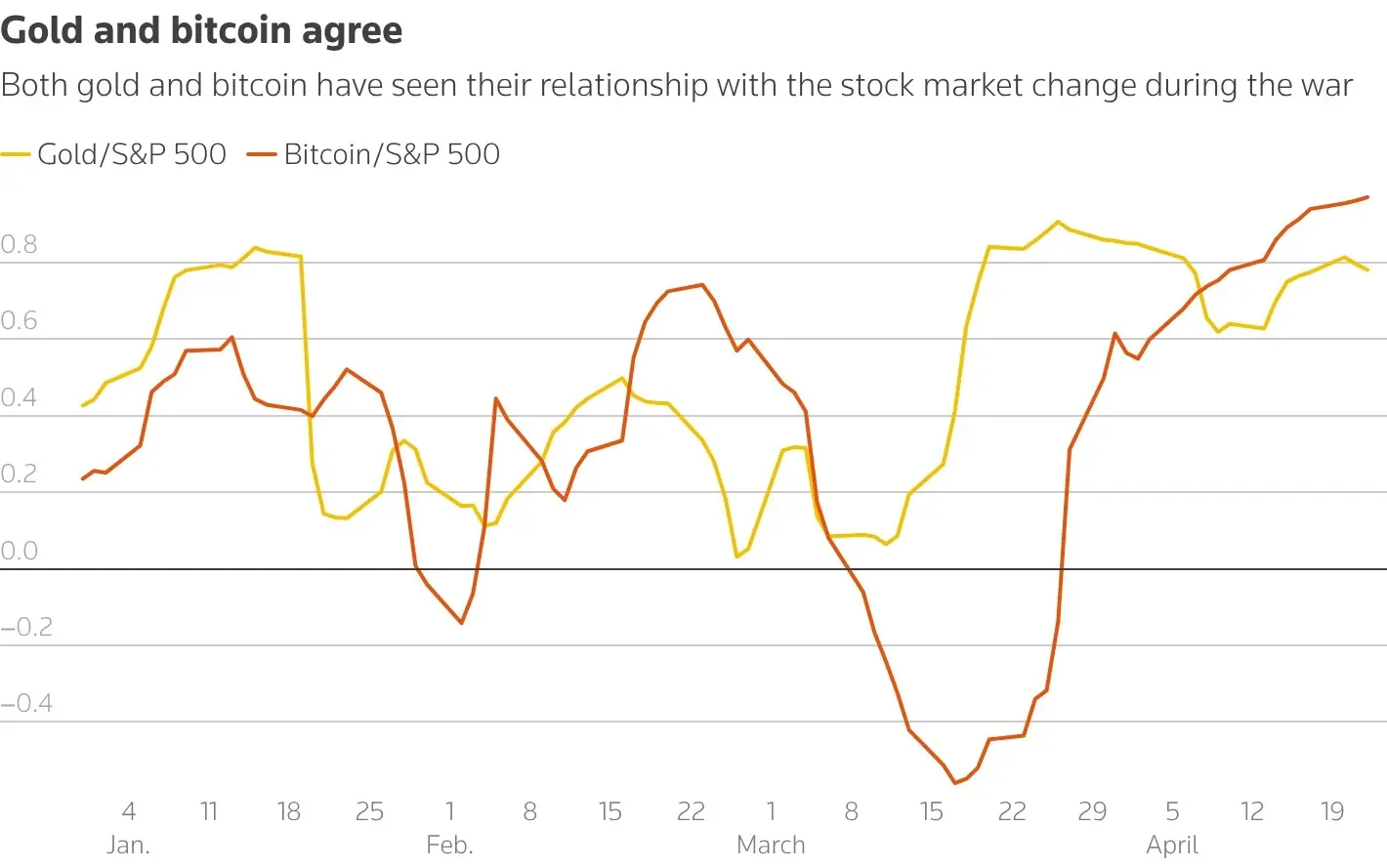
Since late February, the correlation between gold and the dollar has softened to around -0.19 from an average of -0.4, while the correlation between gold and stocks has been around 0.55, up from a five-year average of 0.22.
This probably speaks more to the correlation of the dollar to stocks, which has hit a record -0.94 this week, indicating an almost-perfect inverse relationship, versus a five-year average of -0.28.
Meanwhile, the bitcoin/stocks correlation is at a record 0.96, from an average of 0.4 pre-war, denting the case for crypto as a diversifier.
Extraordinary events have unusual effects
The prospect of an inflation shock has prompted traders to price in rate hikes, particularly in Europe, and to lower expectations of rate cuts in the United States.
Higher rates in one region than another usually imply strength for one currency over another, but even this relationship has broken down.
The European Central Bank is expected to hike rates twice this year, while the Federal Reserve leans towards a cut. Yet the euro, at around $1.17, has barely recovered its war-driven losses.
“Extraordinary events can have unusual effects on financial markets, often altering traditional relationships between financial variables,” UniCredit said, adding that the relationship between euro/dollar and rate differentials is one of those casualties.
Using the difference between two-year US and euro zone swap rates, the correlation between rate differentials and the euro itself is at 0.5, up from near 0 at the start of the year and compared with an average of -0.3 in the last two years.
“We do not think that rate differentials are likely to return to being the key driver for euro/dollar until the war-driven risk premium has dissipated,” UniCredit added.
Divorced from fundamentals
Rising oil prices would normally lift inflation expectations, but these have fallen since the war started. The five-year forward US inflation swap, a gauge of investors’ long-term inflation expectations, is around 2.4pc, from closer to 2.45pc. Oil prices are still around 40pc higher.
The correlation between the two is around -0.7, above the five-year average of 0.2. During the 2022 energy shock, it hit a high of 0.7 following Russia’s invasion of Ukraine.
Deutsche Bank says this switch could be partly down to an expected increase in US fiscal deficits as Washington funds the war.
“But another possibility is that forward inflation compensation has become increasingly divorced from fundamentals,” the bank said.
from Dawn - Home https://ift.tt/UWC6a2i
Comments
Post a Comment