Why is Asia so reliant on Middle Eastern oil?

Asia depends on oil and gas from the Middle East, sourcing 60 per cent of its crude from the region, making it highly vulnerable if the Iran war causes a prolonged closure of the Strait of Hormuz supply ​route.

How much Middle Eastern oil does Asia import?

The Middle East is the world’s largest oil-producing and exporting ‌region, shipping one in four barrels of crude exports daily, mostly through the Strait of Hormuz.
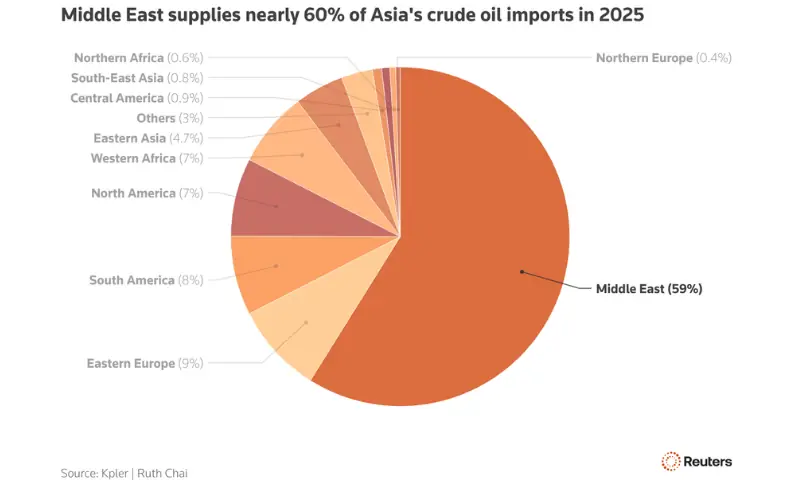
 A pie chart depicting the share of Asia’s crude oil imports in 2025 via percentage. Middle East occupies 59pc of Asia’s crude oil imports — Reuters
A pie chart depicting the share of Asia’s crude oil imports in 2025 via percentage. Middle East occupies 59pc of Asia’s crude oil imports — Reuters

Asia imported 14.74 million barrels per day (bpd) of Middle Eastern crude in 2025, nearly 60pc of the record 25m barrels per day in total purchases for the region, according to data ​from shipping analytics firm Kpler.

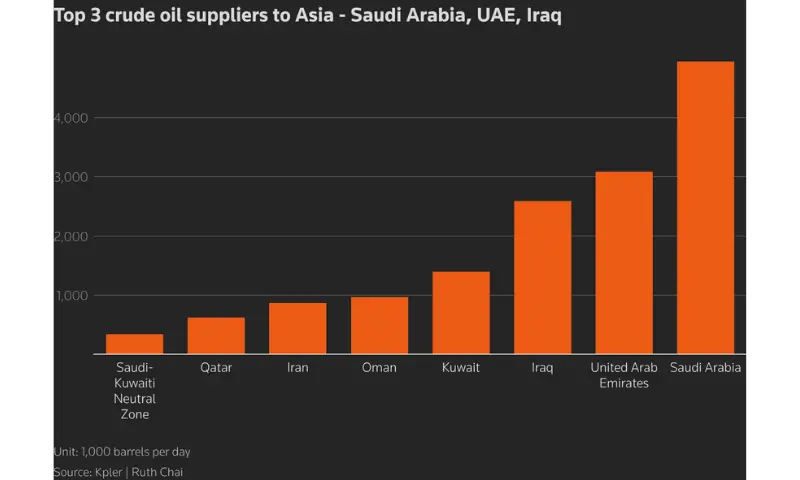
Saudi Arabia, the United Arab Emirates, and Iraq are the region’s top suppliers to ​Asia.

 A bar graph depicting the top crude oil suppliers to Asia. Saudi Arabia supplies a large amount of crude oil, followed by United Arab Emirates and Iraq — Reuters
A bar graph depicting the top crude oil suppliers to Asia. Saudi Arabia supplies a large amount of crude oil, followed by United Arab Emirates and Iraq — Reuters

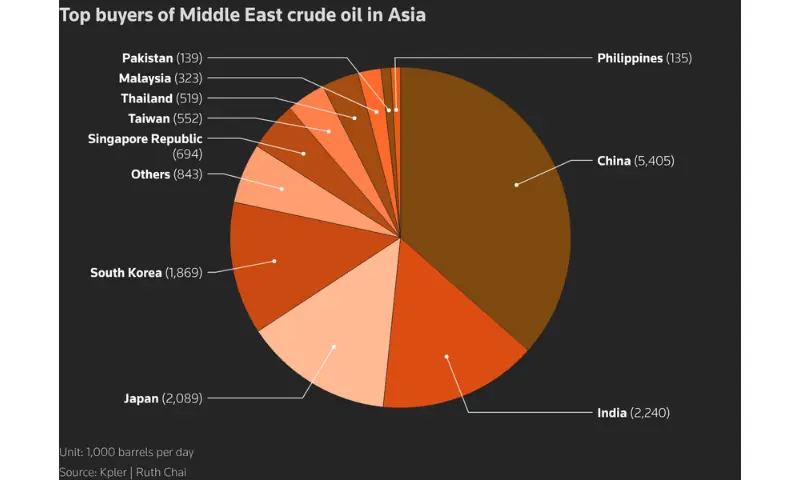
Among major buyers, Japan and South Korea are most reliant on Middle Eastern crude, which accounts ⁠for about 95pc and 70pc of their imports, respectively.

Singapore, Asia’s oil hub, increased its dependence on Middle Eastern oil ​last year to more than 70pc from about 50pc in 2024, after Exxon Mobil, completed a refinery expansion requiring more supply of ​heavy oil from the region.

China, the world’s biggest crude importer, sources about half of its seaborne imports - or 5.4m bpd - from the Middle East, Kpler data showed.

China, which also buys oil from countries including Iran, Russia, and Canada and produces more than 4 million ​bpd on its own, is known in markets for not relying on any one country for more than 20pc ​of its supply.

Middle Eastern oil shipments typically take 30 to 40 days to reach North Asia, and the voyages to India take less than ‌a ⁠week.

A pie chart depicting the top buyers of Middle East crude oil in Asia, per barrels per day — Reuters

Why is Asia so dependent on Middle Eastern oil?

Asia is the world’s fastest-growing region in terms of oil demand, and it is a net importer, as production in the Asia-Pacific region dwindles due to ageing fields and scant new discoveries.

Most Asian refineries are equipped with desulphurisation units to process high-sulphur crude from the Middle East, which is typically cheaper than low-sulphur grades, in order ​to generate higher margins.

Middle Eastern crude ​also contains large amounts of ⁠fuel oil, which can be processed into higher-quality fuels like gasoline and diesel. Fuel oil is also used as bunker fuel at top global refuelling ports, Singapore and Zhoushan in eastern ​China.

Saudi Arabia’s Asian market share, meanwhile, has grown as state energy firm Saudi Aramco ​acquired stakes in ⁠regional refineries to secure outlets for its crude.

Why do Asian refiners have limited alternatives?

While Asian refiners have been increasing the types of crude they can process to diversify their supplies, there is a limit to how much volume they can handle as changing grades affects refined-product ⁠output and ​fuel-blending requirements.

Also, most Asian refiners typically lock in more than 50pc of their ​crude requirements in long-term contracts to ensure stable supplies.


from Dawn - Home https://ift.tt/PUf2dLX

Comments

Popular posts from this blog

Dodgers’ Shohei Ohtani skipping home run derby

Baseball’s biggest star is skipping the home run derby. Shohei Ohtani confirmed after Tuesday’s win over the Diamondbacks that he will not be participating as he continues to rehab an elbow injury that has prevented him from pitching this season. “There’s been some conversations going on,” Ohtani said, according to Juan Toribio of MLB.com . “I’m in the middle of my rehab progression, so it’s not going to look like I’ll be participating.” Manager Dave Roberts said Ohtani and the club reached the decision together. Ohtani signed a historic 10-year, $700-million contract with the Dodgers after winning his second AL MVP award last season with the Angels. Despite his elbow injury, he has served as the Dodgers’ primary DH this season and been one of the most productive hitters in baseball. Ohtani entered Tuesday hitting .316/.399/.635 with a 1.034 OPS. He hit his NL-leading 27th home run in the win. Ohtani had previously participated in the Derby in 2021. Last season’s champion, Vlad...

Pakistan flag installed at UNSC as country becomes non-permanent member for 8th time

The Pakistani national flag was installed in front of the United Nations Security Council chamber, as the country began its eighth term as a non-permanent member (2025-26) of the 15-member body, according to a press release issued by the Permanent Mission of Pakistan to the United Nations on Thursday. Pakistan on Wednesday began a two-year term as a non-permanent member of the United Nations Security Council (UNSC). Elected in June to replace Japan, Pakistan now occupies one of the two Asia-Pacific seats on the UNSC. It will preside over the council in July, a key opportunity to set the agenda and foster dialogue. View this post on Instagram This marks Pakistan’s eighth term on the council, providing an opportunity to shape discussions on pivotal international issues, but also posing significant challenges. “As part of the joining ceremony, flags of the five new incoming non-permanent members — Pakistan, Denmark, Greece, Panam...

Heathrow resumes operations as global airlines scramble after shutdown

London’s Heathrow Airport resumed full operations on Saturday, a day after a fire knocked out its power supply and shut Europe’s busiest airport, causing global travel chaos. The travel industry was scrambling to reroute passengers and fix battered airline schedules after the huge fire at an electrical substation serving the airport. Some flights had resumed on Friday evening, but the shuttering of the world’s fifth-busiest airport for most of the day left tens of thousands searching for scarce hotel rooms and replacement seats while airlines tried to return jets and crew to bases. Teams were working across the airport to support passengers affected by the outage, a Heathrow spokesperson said in an emailed statement. “We have hundreds of additional colleagues on hand in our terminals and we have added flights to today’s schedule to facilitate an extra 10,000 passengers travelling through the airport,” the spokesperson said. The travel industry, facing the prospect of a financial ...