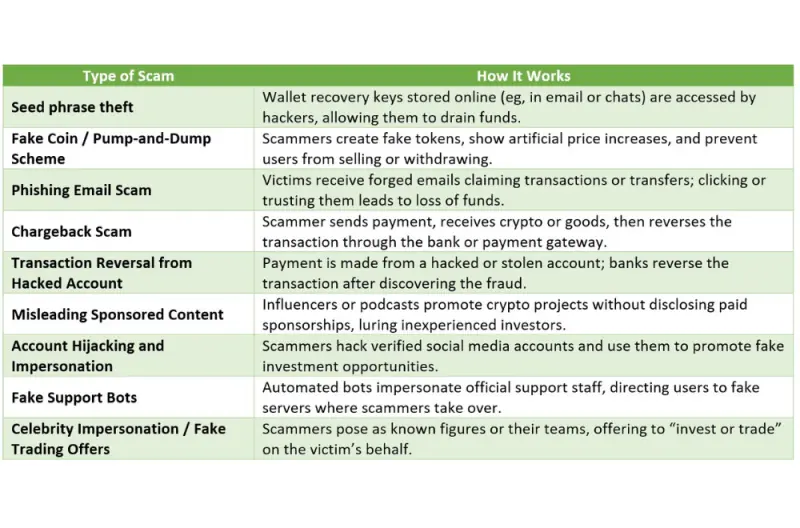
“Never save your wallet key online,” warned Talha, a data scientist with an MS in computer science who works on web development. “I learned that the hard way.”
Despite two-factor authentication (2FA) and strict security on his Facebook account, he lost access to his crypto wallet — not because he clicked a link or downloaded malware, but because months earlier, he had messaged himself his 12-word seed phrase on Facebook Messenger. “There was no login attempt, no alert. The funds just vanished,” he said.
The experience taught him that no system is ever fully secure once your key is exposed. “We think we’re safe behind strong passwords or 2FA, but in reality, anything online is public,” he said.
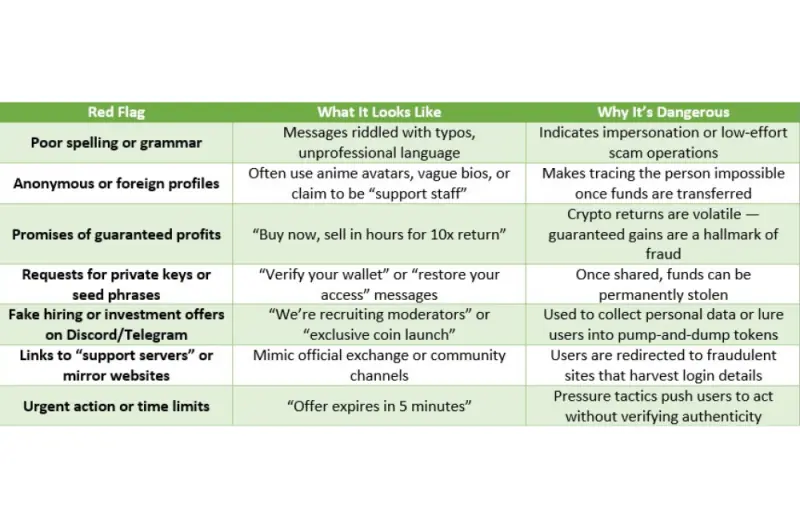
But that wasn’t his only lesson. He was active in several Telegram groups where people discussed new coins. “Someone with a Chinese profile reached out, talking about workouts, lifestyle, and crypto,” he recalled. “It felt like any normal networking chat.” The man introduced him to a supposed “insider” tip: a new coin launch where early buyers could profit within hours.
The token’s value kept rising on paper — his $30 ballooned to $300 — until the moment he tried to sell. “It wouldn’t sell,” he said. “That’s when I knew it was fake. People were still buying, but no one could withdraw. It was just an illusion of growth.”
When Talha confronted the scammer, the man doubled down, urging him to invest $1,000 next time. “That’s how these cons work,” he said. “The first time, they let you win small. Then they trap you when you scale up.”
Talha’s experience was only one of many echoing across Pakistan’s growing crypto community.
The dark side of Pakistan’s crypto boom
An early crypto adopter who now runs a Facebook page called Pakistan iFrauds to report online scams, Muneeb* (name has been changed on the victim’s request) has been on the receiving end of multiple frauds — some elaborate, others deceptively simple. “The first time I got scammed was through phishing,” he said. “I got an email saying funds had been transferred to my account, but I didn’t check. Later, when I reviewed the email headers, I realised it was fake.”
His second experience was through a chargeback scam — a common tactic where the sender reverses a payment after receiving goods or crypto. In another instance, he received a payment from a hacked account. “The bank called to say the transfer came from one of their old and big customers, so they simply reversed the transaction and took the money back from me,” he recalled.
The financial loss was only part of the ordeal. “I even got a case filed against me by authorities,” he said. “I was the one who was scammed, but I had to pay a bribe of Rs700,000 just to close the case.”
Despite everything, Muneeb* remained optimistic about crypto. “Most scams could have been avoided if I had followed standard operating procedures and been less trusting,” he admitted. “I still made a profit overall, so I believe crypto has been beneficial; it’s the future.”
To him, the problem isn’t crypto itself but a lack of awareness. “You can get scammed anywhere — Facebook, online shopping, even a phone call,” he said. “If you’re educated about it, the advantages still outweigh the risks.”
A doctor from Sindh echoed that sense of misplaced trust. Since 2021, he had lost nearly Rs1 million to various crypto schemes. “Podcast hosts don’t disclose sponsorships,” he said. “They misguide viewers by promoting projects that later turn out to be scams.”
A popular celebrity and entertainment journalist once had her Instagram account hacked. After months of follow-up, she finally received a response from the authorities: her account could be restored — but there was a catch.
Her 3,000-plus followers, many of whom she had painstakingly built through boosted posts, had already received private messages promoting “investment opportunities” in crypto coins and wallets. The messages appeared to come from her account, making it seem like she was personally vouching for them.
“Some of my celebrity followers had even received direct messages from my hacked account,” she said. When authorities told her she could reclaim her account, she refused. “What’s the point,” she continued, “of getting it back if my followers think I scammed them?”
The digital ecosystem feeding online fraud
Crypto influencer Waqar Zaka said that scammers are using his name to defraud “over a million people every month.” While the number seems outlandishly high, he said, “People are so gullible and greedy, they don’t want to do research. They see a Telegram or Facebook comment saying, “‘I’m from Waqar Zaka’s team. Send money and I’ll trade for you,’ and they just send it.”
According to him, the issue isn’t just regulatory failure — it’s platform negligence as well. “Instagram, Facebook and Telegram tick marks are fake. Most crypto scams today are happening in comment sections under Facebook and Instagram posts,” he noted.
He added that scammers have shifted their targets. “They don’t even use crypto hashtags. They place ads in front of women watching cooking or drama content. And when those women lose money, they don’t tell their families — they just message me asking for help.”
Zaka argued that the burden lies with global platforms, not just regulators. “Meta profits off viewership from emerging markets; it’s their duty to protect users,” he stated. “The solution isn’t another task force; it’s accountability and awareness.”
He also advises beginners to ignore “get-rich-quick” content entirely. “Instead of random podcasts, learn from credible sources — MIT, Stanford, or official exchange academies,” he said. “If you want to invest, start by educating yourself.”
On the global platforms where crypto conversations thrive — Discord, Telegram, and Reddit — entire networks of scammers operate in plain sight. One insider working at an AI and crypto startup (who requested anonymity due to a non-disclosure agreement) described the scale of it as “an automated business.”
“Scammers routinely post in Discord servers, posing as fake support bots,” he explained. “My newbie friend got his wallet drained that way on his first day. They send friend requests, set up fake ‘support’ servers, and even mimic official channels with thousands of members.”
He described how the con is engineered: “They train illegal bots to automatically message anyone who posts a query. That message redirects users to a fake channel full of scammers and fake users. It’s like a Venus flytrap — once you land there, trained humans take over, using real technical jargon to sound legitimate.”
According to him, major crypto companies have had to hire teams dedicated to tracking such scams. “They target when regular moderators are asleep,” he claimed. “It’s all automated until a real human scammer steps in to close the deal.”
We’re missing a market watchdog
Pakistan ranks third globally in overall crypto adoption, behind only India and the United States, as per the 2025 Global Adoption Index by Chainanalysis. However, nearly all of its activity is retail-driven by small investors. Most transactions take place through centralised exchanges like Binance or local peer-to-peer (P2P) platforms, where scams often take place in Pakistan’s unregulated crypto environment.
Within local crypto circles, frustration is spilling into public view. Bilal Bin Saqib, CEO of the recently launched Pakistan Crypto Council (PCC), recently posted on X, “Should we launch a grievance cell to start investigating these cases?”, replying to a user who lamented, “Bilal bhai, thak gaye hain P2P scams se.”
The exchange highlights how widespread the problem has become and how regulatory and industry responses are still struggling to keep pace. The PCC was contacted for comment, but had not responded by the time this report was published.
There have, however, been concerted efforts in recent months to bring virtual assets trading such as crypto currencies under a regulatory framework — a far cry from State Bank of Pakistan’s position in 2018 when it warned the public that digital assets “are neither recognised as legal tender nor authorised by SBP for issuance, sale, purchase, exchange, or investment”. Fast forward to March 2025, the government established the Pakistan Crypto Council, chaired by the finance minister, signalling a significant shift in attitude.
Soon after, the SBP too clarified its position, saying that its earlier “advice” was “due to the absence of any legal and regulatory framework for the VAs; not because it was declared illegal in the country.”
In July 2025, the Virtual Assets Ordinance (VAO), 2025, established an independent regulator for virtual assets and cryptocurrencies. Under it, the Pakistan Virtual Asset Regulatory Authority (PVARA) has been created as an autonomous federal body empowered to license, regulate and supervise entities dealing in virtual assets.
While its website currently invites expressions of interest from companies seeking licences and registration, most sections still read “launching soon”, which is understandable given that it only came into effect a few months ago.
Given the already high level of crypto adoption in Pakistan, though, regulation and awareness cannot come soon enough.
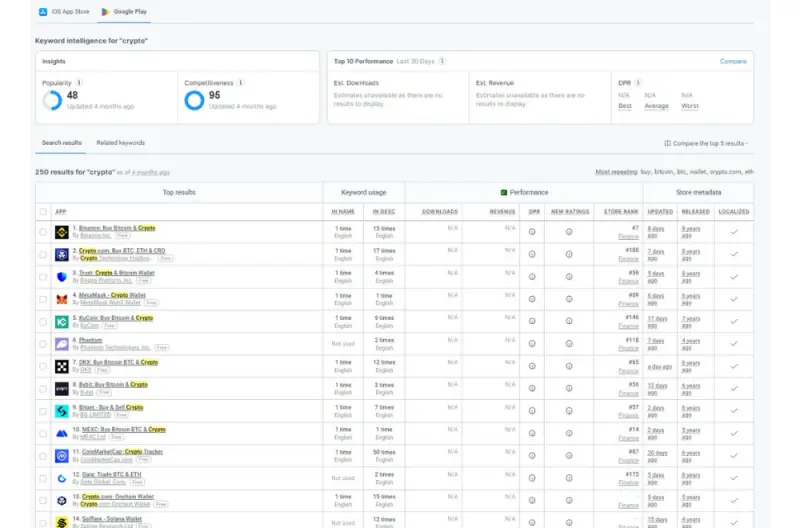
Around 250 apps appear on Google Play in Pakistan when you look up the keyword “crypto”, according to analytics from Appfigures. Global players like Binance, Crypto.com, and Trust Wallet naturally dominate the search results.
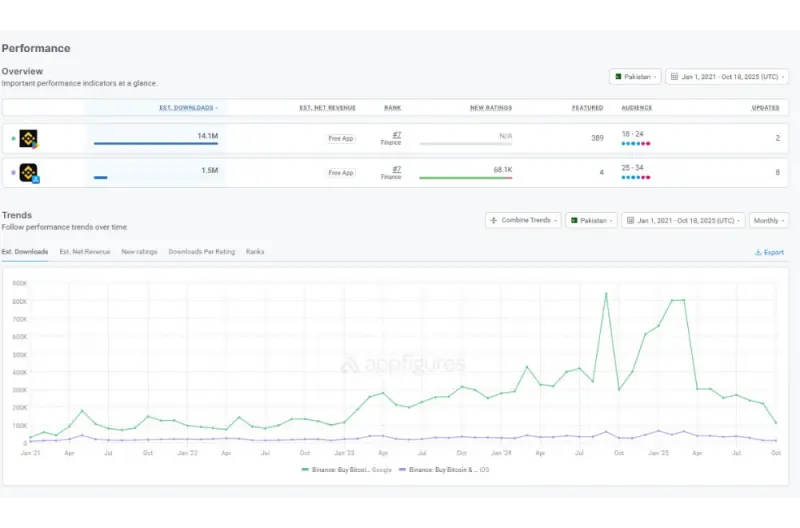
Binance, however, ranks seventh under the finance category, indicating its popularity, which can be further attested by the fact that it has remained the third-most downloaded in finance by Pakistanis for two years straight, according to the Pakistan State of Apps 2024 report by Data Darbar. Binance has had 14.1m downloads on Google Play Store and 1.5m on App Store since 2021, as per Appfigures.
Meanwhile, Appfigures analytics indicates that crypto’s competitiveness score is an astonishing 95, suggesting that demand is fragmented across dozens of platforms. Most of these apps have been around for roughly a decade, but receive frequent updates showing continued local engagement. For Pakistan to protect its crypto investors, the PCC will have to step in to regulate, sooner rather than later.
The price of trust
Fintech expert Zeeshan Ahmed argued that these patterns — social engineering, phishing, and P2P fraud — are all part of a broader financial truth. “For as long as there has been value, be it gold, diamonds, fiat, or now crypto, scams have existed,” he remarked. “The basic rule hasn’t changed: an unsuspecting person is deceived into transferring value. Only the medium has evolved.”
According to him, Pakistan’s crypto ecosystem lacks one key element: trust infrastructure. “Don’t transact in unverified environments,” he recommended. “If you want to trade or store crypto, use a licensed exchange — those operating under regulators in Bahrain or the UAE have oversight so tight that fraud chances are less than one per cent.”
Ahmed stressed that people should verify regulatory claims before trusting a platform. “Go to the Abu Dhabi Global Market’s website — it lists every exchange licensed in the UAE, and even those suspended or under compliance checks,” he advised. “Regulators make that information public. People just don’t look.”
He believes Pakistan doesn’t need to invent new crypto regulations — it just needs to adapt the tested ones. “The beauty of what the Pakistan Crypto Council is trying to do is that they’re adopting globally tested models,” he stated. “The UAE and US frameworks have been stress-tested for years. If those gold-standard systems are replicated here, we won’t have to start from scratch.”
Ultimately, all these stories, from Talha’s vanished funds to hacked accounts and fake bots, point to one truth: the weakest link is still human trust.
As Talha said, “We think we’re safe behind passwords and two-factor authentication. But if the key is online, it’s never really yours.”
from Dawn - Home https://ift.tt/MX08SoY
Comments
Post a Comment